
HomeBlogsExample ItinerariesFrance: 12 days roundtrip from Lyon
France: 12 days roundtrip from Lyon

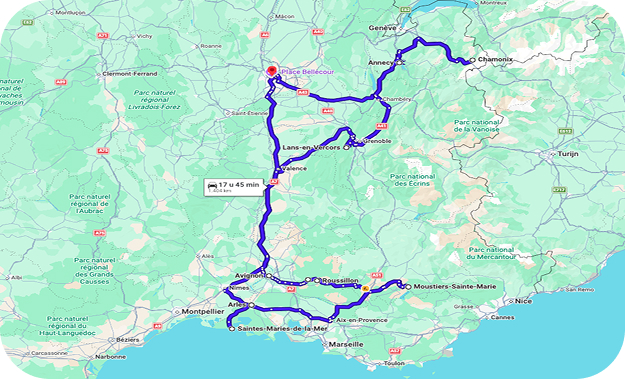
A RV road trip through France gives you plenty of variety without covering huge distances every day. This 12-day route starts in Lyon and heads east toward Lake Annecy, with the Alps appearing on the horizon as you approach the lake. From Annecy, continue deeper into the mountains to Chamonix, where glaciers lie between the surrounding peaks. Farther south, limestone cliffs and high plateaus shape the Vercors before the route reaches the vineyards and stone villages of Provence.
The route starts and ends in Lyon, making it suitable for a round-trip RV rental from Lyon.
Day 1: Lyon
Start in Lyon, where the Rhône and Saône rivers meet. Between the Saône and Fourvière Hill lies Vieux Lyon, with narrow streets, courtyards and traboules. These passageways run through buildings and connect one street with another. From the old town, walk uphill or take the funicular to Fourvière for views across Lyon's rooftops.
Lyon has a long culinary tradition. Take a seat in a bouchon, a traditional Lyonnaise bistro serving classic local dishes.
Day 2: Lyon – Annecy, approx. 90 mi (145 km) – 2 hours
The first drive takes you from Lyon toward the French Alps. After about 2 hours, you reach Annecy on the shores of Lake Annecy. Canals run between pastel-colored facades and narrow streets in the historic center. In the middle of the Thiou River stands the Palais de l'Île, a medieval building that served several purposes over the centuries, including as a prison. From here, continue toward the lake and follow the waterfront promenade.
During the warmer months, much of daily life shifts to the lakeshore. Beaches and grassy areas line parts of the water, while boats depart from Annecy for trips across the lake. Spring and fall are generally milder, making them good times for walking and cycling around the lake.
Day 3: Annecy
Leave the RV parked and explore Lake Annecy by bike. The official cycling route around the lake is approximately 25 mi (40 km) long and passes villages, beaches and stretches directly beside the water. In summer, several beaches along the route provide access to the lake for a swim. Boat trips and kayak rentals are available around the lake, with views back toward Annecy and the surrounding mountains.
Day 4: Annecy – Chamonix-Mont-Blanc, approx. 62 mi (100 km) – 1.5 hours
The road continues into the French Alps to Chamonix, which lies in a narrow valley at the foot of the Mont Blanc massif. From the town center, the cable car reaches the Aiguille du Midi at an elevation of 12,605 ft (3,842 m) in about 20 minutes. Its viewing terraces look across the French, Swiss and Italian Alps and toward Mont Blanc.
The cogwheel train to Montenvers offers a second mountain excursion. The station lies at 6,276 ft (1,913 m), near the Mer de Glace. The glacier lies below the station, surrounded by steep Alpine peaks.
Day 5: Chamonix-Mont-Blanc – Lans-en-Vercors, approx. 109 mi (175 km) – 2.5 hours
In the Parc naturel régional du Vercors, the glaciers around Chamonix give way to limestone cliffs, forests and open high plateaus. Lans-en-Vercors sits on one of these plateaus, surrounded by mountain ridges.
Across the park, Alpine meadows and forests alternate with limestone plateaus, while the highest areas rise above 6,560 ft (2,000 m). Some roads through the Vercors are narrow and winding, so check your route against the dimensions and weight of your RV before setting off.


Day 6: Lans-en-Vercors – Avignon, approx. 127 mi (205 km) – 2.5 hours
Descend from the Vercors into the Rhône Valley and continue south to Avignon. Inside the city walls stands the Palais des Papes, largely built between 1335 and 1352. Avignon Tourisme describes it as the largest Gothic palace in the world. The building dates from the period when Avignon was a center of papal power during the 14th century.
A few streets away, the Rhône flows past the Pont Saint-Bénézet, better known as the Pont d'Avignon. The medieval bridge originally had 22 arches; four remain today. In July, Festival d'Avignon brings performances to theaters, public squares and the Cour d'Honneur of the Palais des Papes.
Day 7: Avignon – Luberon, approx. 31 mi (50 km) – 1 hour
The drive to the Luberon is only about 31 mi (50 km), leaving most of the day for the villages. Start in Gordes, where stone houses rise in terraces along the hillside. From the edge of the village, the view stretches across the valley and surrounding hills.
In Roussillon, ochre in the soil colors the rocks and facades yellow, orange and deep red. Lavender flowers in parts of Provence around late June and July, although timing varies with elevation, location and weather. Flowering varies across the region, so lavender won't necessarily be in bloom everywhere at the same time.
Day 8: Luberon – Gorges du Verdon, approx. 68 mi (110 km) – 2 hours
Head east from the Luberon toward the Gorges du Verdon. Here, the Verdon River has cut through the limestone before reaching Lac de Sainte-Croix at the western end of the gorge.
Moustiers-Sainte-Marie sits against the cliffs above the valley and has been known for centuries for its faience pottery. High between two cliffs, a star hangs from a chain above the village and is linked to several local legends. A stone path climbs from the village streets to the Notre-Dame de Beauvoir chapel. Roads around the Verdon include narrow, steep and winding sections.
Day 9: Gorges du Verdon
Canoes, kayaks and pedal boats are available at Lac de Sainte-Croix for trips toward the entrance of the gorge. The open water narrows as you enter, with limestone cliffs rising on both sides. The Verdon River begins in the Alps and eventually joins the Durance on its way toward the Rhône. Between Castellane and Lac de Sainte-Croix, it cuts deeply through the limestone. The lake itself was created in 1973 following the construction of the dam.
Day 10: Gorges du Verdon – Arles, approx. 93 mi (150 km) – 2.5 hours
Drive west through Provence to Arles, where Roman remains are spread throughout the city center. The Roman amphitheater dates from around AD 90 and once accommodated approximately 21,000 spectators. Events are still held there today.
Arles also has close ties to Vincent van Gogh. He lived in the city from 1888 and created hundreds of works during his time there. Walk past Place du Forum and the courtyard of the former hospital where he stayed. Several Roman structures and places connected with his paintings lie within walking distance of one another.


Day 11: Arles – Saintes-Maries-de-la-Mer – Arles, approx. 47 mi (75 km) – 1 hr 15 min
South of Arles lies the Camargue. Across this Rhône delta, lagoons, wetlands, reed beds, salt flats and open grasslands alternate across the landscape. White Camargue horses and black cattle live among the wetlands, while flamingos and other waterbirds forage in the shallow water.
At Parc Ornithologique du Pont de Gau, walking trails run between ponds, marshes and reed beds. The 148-acre (60-hectare) area attracts many bird species, including hundreds of flamingos. Continue from there to Saintes-Maries-de-la-Mer on the Mediterranean coast. After the mountains at the beginning of the trip, the landscape here is almost completely flat, with water and reeds stretching across the horizon.
Day 12: Arles – Lyon, approx. 162 mi (260 km) – 3 hours
The final 162 mi (260 km) follows the Rhône Valley back toward Lyon and takes about 3 hours. Plan your departure around the RV return time. If you have an early drop-off, spending the final night closer to Lyon may make the return easier.
Practical information for this route
-
Travel period: May, June, September and early October generally combine suitable conditions in Provence with opportunities to explore the Alps. July and August are busier around Annecy, Provence and the Verdon. Lavender generally flowers around late June and July, depending on location, elevation and weather.
-
Mountain lifts: Operating schedules around Chamonix depend on the season and weather. The Aiguille du Midi and Montenvers have separate operating calendars, so check both before your visit.
-
Campgrounds and RV stops: Campgrounds and French RV stops, known as aires de camping-car, are available along the route. Locations around Annecy, Chamonix and the Verdon tend to fill more quickly in July and August.
-
Mountain roads: Expect narrow, steep and winding roads in parts of the Vercors and around the Gorges du Verdon. Check the dimensions and weight of your RV when planning these sections.
-
Toll roads: Several French highways on or near this route charge tolls. The amount depends partly on the vehicle class.
-
Low-emission zones: Crit'Air and low-emission regulations apply in several French cities. Rules differ by area and can change, so check the current requirements before departure.
-
Overnight stays near the Verdon: Wild camping restrictions apply around the lakes and in protected parts of the Gorges du Verdon. Stay at a campground, RV stop or another designated overnight location.
-
Temperature differences: Chamonix and the Vercors sit much higher than Provence and the Camargue. Pack for cooler mountain conditions as well as warmer days farther south.
-
Adjusting the route: With about 10 days, skip the overnight stay in the Vercors and continue from Chamonix toward Avignon. With 14 days, spend an extra day in Chamonix for another mountain excursion or stay longer at the Verdon for hiking or time on the water.
After 12 days, the route returns to Lyon. By then, the glaciers and mountain lakes of the first few days have given way to the ochre cliffs and villages of Provence, followed by the lagoons and reed beds of the Camargue. Ready to plan your own route? Explore RV rental in France or view the available RVs for rent in Lyon.