
HomeBlogsExample ItinerariesScotland: North Coast 500 and the Highlands in...
Scotland: North Coast 500 and the Highlands in 14 Days

The North Coast 500 is one of Scotland’s best-known road trip routes, taking you through the far north of the country. Along the way, long sandy beaches, sea lochs, fishing villages, open moorland, and the mountains of the Highlands create a constantly changing landscape. Combine the northern coast with Wester Ross, Glen Coe, and Loch Lomond for a varied RV road trip through Scotland.
This 14-day sample itinerary starts and ends in Edinburgh. You’ll drive the North Coast 500 counterclockwise, first following the east coast north before traveling along the more rugged north and west coasts on your way south. Two weeks gives you time to travel at a comfortable pace, with opportunities for hikes and longer stops along the way.
When traveling by RV, it’s a good idea not to plan too many miles in a single day. There are many single-track roads along the north and west coasts, so average driving speeds can be low. The driving times below are therefore approximate and do not include longer stops.
Want to drive this route yourself? Explore the options for RV rental in Scotland.
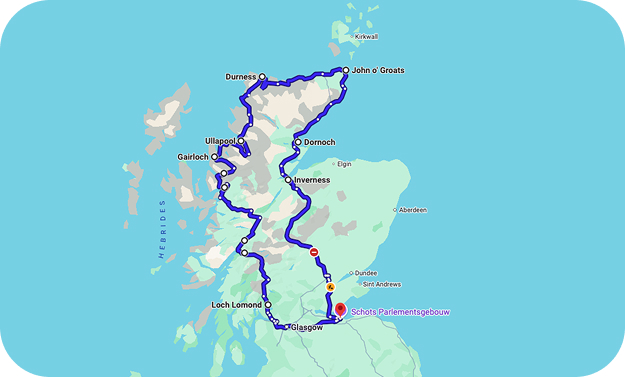
Day 1: Edinburgh – Pitlochry, approx. 68 mi (110 km) – 2 hours
After picking up your RV, leave Edinburgh and head north. Cross the Firth of Forth and continue via Perth to Pitlochry, on the edge of the Highlands. Don’t plan too much for your first day. The vehicle orientation, getting settled in your RV, and grocery shopping can easily take up part of the day. If you have some time left, explore Pitlochry on foot or take a walk along the River Tummel.
Day 2: Pitlochry – Inverness, approx. 87 mi (140 km) – 2 hours
Follow the A9 north through the Highlands. Along the way, you’ll pass through Cairngorms National Park. Aviemore makes a convenient stop for a walk or lunch before continuing to Inverness. Located on the River Ness, Inverness marks the official start and finish of the North Coast 500. If you have enough time, you can also make a side trip toward Loch Ness.
Day 3: Inverness – Dornoch, approx. 43 mi (70 km) – 1 hour
Today you begin the North Coast 500. Leave Inverness and travel via Beauly and Dingwall toward the east coast. If you have extra time, consider a detour around the Black Isle.
Continue north to Dornoch. Its historic center is compact enough to explore on foot, and there is a long sandy beach just outside town. Dornoch is also a convenient place to stock up on groceries and fuel before traveling farther into the sparsely populated north.
Day 4: Dornoch – John o’ Groats, approx. 81 mi (130 km) – 2 hours
Follow the east coast through Sutherland and Caithness. Near Golspie, you can stop at Dunrobin Castle, located close to the sea and recognizable by its many towers and formal gardens.
Continue via Wick to John o’ Groats. If you want to visit the northernmost point of mainland Great Britain, continue to Dunnet Head. Duncansby Head is another worthwhile stop. From the parking area, you can walk toward the cliffs and the distinctive rock formations known as the Duncansby Stacks.
Day 5: John o’ Groats – Durness, approx. 93 mi (150 km) – 3 hours
Today you turn west and enter one of the most remote sections of the NC500. Travel via Thurso along Scotland’s north coast toward Bettyhill and Tongue. Dunnet Bay is a good place to stop for a walk on the beach. After Tongue, you’ll encounter more single-track roads with passing places. Driving these roads in an RV may take some getting used to. Take your time, look well ahead, and use passing places both for oncoming vehicles and to allow faster traffic behind you to pass.
The day ends in Durness, where cliffs and broad sandy beaches define the coastline.
Day 6: Durness
Leave the RV parked as much as possible today and explore the area on foot. Smoo Cave lies on the edge of Durness and can be reached by a walking trail and steps. The cave is unusual because both the sea and a freshwater stream have played a part in its formation. Balnakeil Bay and Sango Bay are also good options for a walk. Keep your plans flexible, as the weather in northern Scotland can change quickly. If you wake up to a dry morning, it may be the best time for a longer hike.
Day 7: Durness – Ullapool, approx. 68 mi (110 km) – 2 hours
Although today’s distance may seem relatively short, allow plenty of time for the drive. From Durness, travel south via Scourie and Kylesku through a sparsely populated landscape of lochs, rocky hills, and scattered beaches. At Kylesku, cross the sea loch on the distinctive Kylesku Bridge before continuing through Assynt. If you are driving a larger RV, it is advisable to avoid the narrow B869 via Drumbeg and follow the alternative route suitable for larger vehicles. Official NC500 route information recommends this as well.
Eventually, you’ll arrive in Ullapool on Loch Broom. After traveling through the remote northwest, this is a useful place to stock up on groceries, fuel, and other supplies.


Day 8: Ullapool – Gairloch, approx. 56 mi (90 km) – 1.5 hours
After leaving Ullapool, consider stopping at Corrieshalloch Gorge. Walking trails and bridges provide views into the deep gorge carved by the river below. Continue through Wester Ross toward Poolewe and Gairloch, passing mountains and sea lochs along the way. With a relatively short driving distance today, you’ll have time for a beach walk or a short hiking trail in the area.
This section also shows why a compact RV can be convenient in the Highlands. Narrow roads, small parking areas, and spontaneous stops are generally easier to manage in a smaller vehicle.
Day 9: Gairloch – Torridon, approx. 31 mi (50 km) – 1 hour
A short distance in Wester Ross doesn’t necessarily mean a quick drive. The roads are winding and often narrow, and there are several places where you may want to stop along the way. Around Torridon, the landscape becomes increasingly mountainous, with peaks rising steeply above the glens and lochs. Since today’s drive is short, you’ll have much of the day available to explore the area. Choose a hike that suits your experience and the conditions, and always check the latest mountain weather before heading out.
Day 10: Torridon – Lochcarron, approx. 28 mi (45 km) – 1 hour
Today is deliberately another short driving day, giving you more time to experience Wester Ross rather than rushing through this part of the Highlands. From Torridon, follow Upper Loch Torridon toward Shieldaig before continuing to Lochcarron. Stop where it is safe to do so for short walks and views across the sea lochs and surrounding mountains.
This RV itinerary deliberately does not include the Bealach na Bà road to Applecross. This historic mountain road is extremely narrow, with steep gradients and tight hairpin bends. The official North Coast 500 organization advises larger motorhomes to use the alternative route. Even in a smaller RV or campervan, experience driving on narrow mountain roads is important.
Lochcarron provides a quiet place to spend the night before continuing south the following day.
Day 11: Lochcarron – Fort William, approx. 87 mi (140 km) – 3.5 hours
Today you leave the North Coast 500 behind and continue through the western Highlands. Follow the main route toward Kyle of Lochalsh before heading south. Along the way, consider stopping at Eilean Donan Castle near Dornie. The castle occupies a small tidal island where three sea lochs meet. Continue through Glen Shiel and past a series of lochs toward Fort William.
Fort William lies at the foot of Ben Nevis, the highest mountain in the United Kingdom. Climbing Ben Nevis is a serious mountain hike that requires enough time, appropriate equipment, and suitable weather conditions. For an easier option, choose one of the shorter walks in Glen Nevis or around Fort William.
Day 12: Fort William – Glen Coe, approx. 19 mi (30 km) – 30 min
There is deliberately very little driving today. From Fort William, follow Loch Linnhe toward Ballachulish and Glen Coe. With such a short drive, you’ll have almost the entire day to explore. Visit the visitor center or choose a hike through the glen. Glen Coe is a place where it’s worth leaving the RV parked for a few hours rather than simply driving through.
Even when the weather looks good, bring warm and waterproof clothing. In the mountains, temperature, wind, and visibility can change quickly.
Day 13: Glen Coe – Loch Lomond, approx. 62 mi (100 km) – 1.5 hours
Follow the A82 south from Glen Coe. The road first crosses Rannoch Moor, an open landscape of moorland, water, and mountains. Continue via Bridge of Orchy toward Loch Lomond. Use the afternoon for a walk along the loch or check locally for opportunities to get out on the water.
Pay particular attention to where you stay overnight in this area. Camping Management Byelaws apply in parts of Loch Lomond & The Trossachs National Park from March 1 through September 30. Within designated Camping Management Zones, you may need to use a campground or reserve a permit in advance. Check the current regulations before your trip and choose an appropriate overnight location.
Day 14: Loch Lomond – Edinburgh, approx. 81 mi (130 km) – 2.5 hours
The final leg takes you back to Edinburgh. Check your RV drop-off time in advance and allow plenty of extra time. You may also need time to refuel and prepare the RV for return according to your rental company’s requirements.
If you have an extra night in Edinburgh after your RV trip, finish your journey by exploring the Old Town, visiting Edinburgh Castle, or walking up Arthur’s Seat.
Practical information for this route
-
Choose your RV carefully: the North Coast 500 includes many single-track roads and small parking areas. A compact RV or campervan is easier to maneuver in these conditions. If you are traveling in a larger vehicle, check in advance which roads are suitable.
-
Take your time on single-track roads: use passing places for oncoming vehicles and to allow faster traffic behind you to pass. Never park in a passing place. Occasionally, you may need to reverse to the nearest passing place.
-
Avoid certain roads in a larger RV: official North Coast 500 information advises larger motorhomes not to drive Bealach na Bà or the B869 near Drumbeg. Use the recommended alternative routes.
-
Consider the shoulder seasons: July and August are among the busiest months. June and September can also be good times to travel. Outside the peak season, keep in mind that days may be shorter and some businesses and attractions may have reduced opening hours.
-
Make reservations where necessary: during busy travel periods, it is a good idea to reserve campgrounds and popular activities in advance. This reduces the chance of having to search for an alternative at the end of a long driving day.
-
Mix different types of overnight stops: regularly plan a stay at a campground or official motorhome stop with facilities. This makes it easier to refill fresh water, dispose of wastewater, and use an electrical hookup when needed.
-
Wild camping rules are different for RVs: Scotland’s responsible wild camping access rights relate to lightweight camping and do not provide a general right to drive, park, or stay overnight on land in a motor vehicle. Always respect signs, parking restrictions, and local regulations, and use suitable campgrounds, motorhome stops, or other locations where overnight parking is permitted.
-
Pay extra attention around Loch Lomond: special Camping Management Byelaws apply in certain parts of Loch Lomond & The Trossachs National Park from March 1 through September 30. Check in advance whether your chosen overnight location requires a permit or campground reservation.
-
Plan regular service stops: facilities are farther apart in the far north and west. Refill water, buy groceries, and refuel when it is convenient rather than waiting until supplies are running low.
-
Download offline maps: cell service can be limited in remote parts of the Highlands. Offline maps are useful for navigation and for finding campgrounds, gas stations, and other facilities.
-
Dress in layers: sunshine, rain, wind, and cooler temperatures can follow each other quickly. Bring a waterproof jacket, a warm mid-layer, and sturdy hiking shoes. Even after a sunny day, evenings can become quite cool.
-
Be prepared for midges: these tiny biting insects can be a nuisance during the warmer months, particularly in damp, sheltered, and windless areas. A more open overnight location with some breeze can be more comfortable.
-
Leave room in your daily schedule: a distance that looks short on the map can take considerably longer on the NC500. Single-track roads, oncoming traffic, livestock, hikes, and spontaneous stops all affect your travel time. Two weeks gives you more freedom to experience the north and west coasts without rushing.