
HomeBlogsExample ItinerariesRoundtrip Iceland in 12 days
Roundtrip Iceland in 12 days

Iceland’s Ring Road, officially Route 1, forms a large loop around the island. It is a natural choice for a camper trip, taking you past waterfalls, black-sand beaches, glaciers, lava fields, geothermal areas, and small coastal towns. With 10 to 14 days, you can experience many of Iceland’s best-known places along and near the Ring Road.
This sample itinerary starts and ends in Reykjavík and follows the Ring Road counter-clockwise from the south. The main route takes you through southern, eastern, and northern Iceland before returning via Borgarnes. If you have extra time, you can add an optional trip to the Snæfellsnes Peninsula before heading back to Reykjavík.
Planning your own trip? Explore the options for RV and camper rental in Iceland before setting out on the Ring Road.
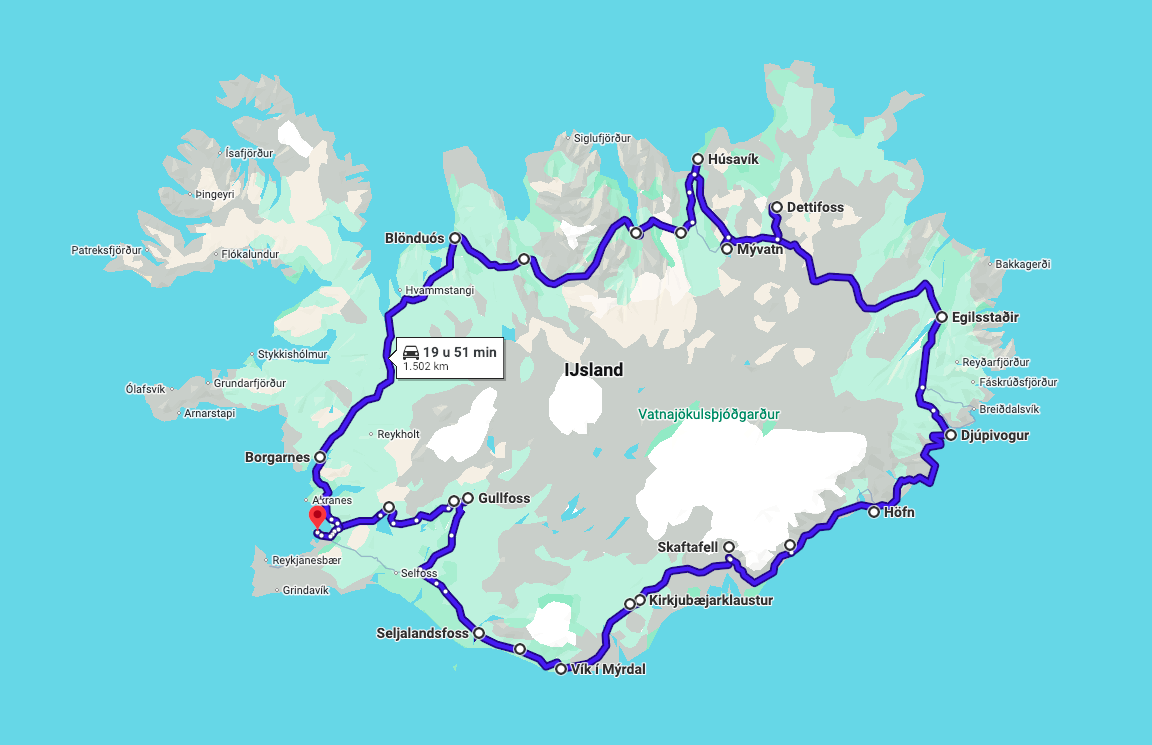
Day 1: Reykjavík – Þingvellir – Geysir, approx. 68 mi (110 km) – 1.5 hours
After picking up your camper, start with a relatively short drive from Reykjavík toward the Golden Circle. Your first major stop is Þingvellir National Park. The area is known both for its geological setting along the boundary of two tectonic plates and for its important role in Icelandic history.
Continue to the Geysir geothermal area. The original Geysir is usually quiet today, but nearby Strokkur erupts regularly. There are several camping options in the surrounding area.
Day 2: Geysir – Gullfoss – Seljalandsfoss – Skógar, approx. 93 mi (150 km) – 2 hours
Start the day at Gullfoss, where the Hvítá River drops into a rugged canyon. From here, head back toward Route 1 and begin your journey along Iceland’s south coast. A logical stop is Seljalandsfoss. Continue to Skógafoss, a broad waterfall located close to the Ring Road. The Skógar area makes a convenient overnight stop and gives you time to explore on foot.
Day 3: Skógar – Vík – Fjaðrárgljúfur – Kirkjubæjarklaustur, approx. 93 mi (150 km) – 2 hours
Drive toward Vík, stopping along the way at Dyrhólaey and the black-sand beach of Reynisfjara. In the right season (roughly May through August), Dyrhólaey is also a great spot to see puffins. Waves along this stretch of the Atlantic coast can be extremely powerful. Always stay well back from the water and follow local safety warnings.
Beyond Vík, the scenery changes again as you cross broad areas of volcanic sand and lava fields toward Kirkjubæjarklaustur. If time and conditions allow, make a detour to Fjaðrárgljúfur canyon.
Day 4: Kirkjubæjarklaustur – Skaftafell – Jökulsárlón, approx. 80 mi (130 km) – 1.5 hours
Today takes you through one of the most varied sections of southern Iceland. Route 1 runs along the southern edge of Vatnajökull, Iceland’s largest ice cap. Plan a longer stop at Skaftafell, part of Vatnajökull National Park. Several hiking trails start here. One popular walk leads to Svartifoss, a waterfall framed by dark basalt columns. Continue to Jökulsárlón, where icebergs that have broken away from Breiðamerkurjökull drift across the glacial lagoon. On the other side of the road is Diamond Beach, where pieces of ice can wash ashore on the black sand.
Day 5: Jökulsárlón – Höfn – Djúpivogur, approx. 105 mi (169 km) – 2.5 hours
Follow Route 1 along the southeastern coast toward Höfn. Along the way, you will regularly see outlet glaciers descending from Vatnajökull and mountains rising close to the coastline. After Höfn, the road becomes more winding as you enter the Eastfjords. Take your time here. Distances may look relatively short, but winding roads and scenic stops can make the journey longer than expected. Djúpivogur is a small harbor town and a convenient place to spend the night.
Day 6: Djúpivogur – Egilsstaðir, approx. 53 mi (85 km) – 1 hour
The route through eastern Iceland follows fjords, mountain slopes, and small coastal communities before turning inland toward Egilsstaðir. This part of the Ring Road generally feels quieter than the popular south coast. Egilsstaðir is the main service center of eastern Iceland and a useful place to stock up on groceries and fuel. If you have enough time, you can also explore the area around Lake Lagarfljót.
Day 7: Egilsstaðir – Dettifoss – Lake Mývatn, approx. 137 mi (220 km) – 3 hours
From Egilsstaðir, drive through increasingly open and sparsely populated landscapes toward northeastern Iceland. Along the way, make a detour to Dettifoss, one of Europe’s most powerful waterfalls. Continue toward Lake Mývatn. The area combines volcanic landscapes, craters, lava formations, and geothermal features within relatively short driving distances. Because there is plenty to see, it is worth allowing extra time in this region.
Day 8: Lake Mývatn
Leave the camper parked for part of the day or make only short drives around the Lake Mývatn area. Walk among the unusual lava formations at Dimmuborgir and visit Hverir, where steam rises from the ground and bubbling mud pots reveal the geothermal activity below the surface.
The Krafla area and Hverfjall crater are other worthwhile options. Rather than trying to see everything in one day, choose a few places and allow enough time to explore them properly.
Day 9: Lake Mývatn – Húsavík – Goðafoss – Akureyri, approx. 112 mi (180 km) – 2.5 hours
Drive north to Húsavík on Skjálfandi Bay. The town is particularly well known as a departure point for whale-watching trips. If you plan to join an excursion, allow a substantial part of the day for it. Continue toward Akureyri, stopping at Goðafoss along the way. Here, the Skjálfandafljót River flows over a wide, curved drop. Akureyri is the main urban center of northern Iceland. Walk through the compact downtown area, visit the botanical garden, or use your stop here to stock up before continuing west.
Day 10: Akureyri – Varmahlíð – Blönduós, approx. 90 mi (145 km) – 2 hours
After several activity-filled days around Lake Mývatn, today’s drive is intentionally shorter. Follow Route 1 west from Akureyri through valleys and mountain passes. The area around Varmahlíð is known for Icelandic horse breeding, and horseback riding excursions are available in the region. Continue along the Ring Road to Blönduós, located near the mouth of the Blanda River.
Day 11: Blönduós – Borgarnes, approx. 105 mi (170 km) – 2 hours
Continue south on Route 1. The scenery is dominated by broad valleys, mountains, and farmland, with farms and small settlements scattered along the way. Borgarnes sits on Borgarfjörður and is a convenient final overnight stop before returning to Reykjavík. Travelers interested in Iceland’s early history can visit the Settlement Center.
Day 12: Borgarnes – Reykjavík, approx. 47 mi (75 km) – 1 hour
From Borgarnes, follow Route 1 south toward Reykjavík. This is a relatively short final driving stage, leaving time to explore Iceland’s capital before returning your camper. Walk around the old harbor and downtown area, visit Hallgrímskirkja, or simply use the afternoon to relax after your journey around Iceland.
Depending on your camper return time, you may want to stay near Reykjavík for your final night. Allow enough time to prepare the camper for return according to your rental conditions, refuel if required, and drive to the rental location. You can find the available vehicles and rental information on the RV rental Reykjavík page.


Optional extension: Snæfellsnes Peninsula and Grundarfjörður
If you have 2 more days available, consider adding the Snæfellsnes Peninsula rather than driving directly from Borgarnes to Reykjavík. This detour is not essential to completing the Ring Road, but it adds another distinctly different part of western Iceland to your trip. From Borgarnes, drive onto the Snæfellsnes Peninsula and explore its coastline, lava fields, fishing villages, and views toward Snæfellsjökull. Arnarstapi and Hellnar are good stops for short coastal walks between basalt formations and cliffs.
Continue around the peninsula toward Grundarfjörður. Just outside town, Kirkjufell rises above the surrounding coastline. Nearby Kirkjufellsfoss is a popular viewpoint, where the small waterfall can be photographed with Kirkjufell in the background. Grundarfjörður is a practical place to spend the night before continuing back to Reykjavík the following day.
Allow approximately two additional days if you want to explore Snæfellsnes without rushing. Weather and road conditions can affect driving times, so keep some flexibility in your schedule.
Practical information for this route
-
Trip duration: The main Ring Road itinerary can be adapted to approximately 10 to 12 days by combining selected stages. With 13 or 14 days, you can travel at a slower pace or add the optional Snæfellsnes Peninsula extension.
-
Best time to travel: For a first camper trip around the complete Ring Road, the summer months are generally the most practical because of the long daylight hours and typically better road conditions. Weather can still change quickly, even in summer.
-
Road conditions: Check current road conditions and the weather forecast every day. Strong winds, rain, snow, and other conditions can affect both travel times and road accessibility.
-
F-roads: This itinerary is designed around Route 1 and regular connecting roads. Do not enter an F-road without checking the restrictions first. Iceland’s mountain roads have vehicle requirements, and you should always confirm that your rental camper is permitted on the specific road under your rental conditions.
-
Camping: Campervans and motorhomes cannot simply be parked anywhere in Iceland for an overnight stay. Plan to use designated campgrounds or locations where you have explicit permission to stay.
-
Campgrounds: Not every campground operates year-round. Outside the main summer season, check which campgrounds along your planned route are open before setting out.
-
Fuel: Refuel in good time, especially before longer drives through sparsely populated areas. Larger communities such as Reykjavík, Höfn, Egilsstaðir, Akureyri, and Borgarnes have more services.
-
Weather and wind: Strong winds deserve particular attention when traveling by camper. Adjust your speed to the conditions and be careful when opening camper doors. Keep some flexibility in your schedule so you can postpone or adjust a driving leg when necessary.
-
Reservations: Popular excursions, campgrounds, and activities can be busy during summer. Consider booking activities that are important to your trip, such as a whale-watching tour from Húsavík, in advance.
-
Driving times: All driving times in this itinerary are approximate and do not include longer stops. Driving a particular distance in Iceland can take longer than expected because of road conditions, weather, and frequent sightseeing stops.
Ready to plan your own Ring Road trip? Compare the options for RV rental in Iceland and choose a vehicle that fits your travel dates, group size, and preferred way of traveling.