
HomeBlogsExample ItinerariesGermany from the Netherlands in 14 days
Germany from the Netherlands in 14 days

Germany is an ideal destination for a camper road trip from the Netherlands: crossing the border is easy, and in a single vacation you can combine wine regions, historic cities, forests, and the foothills of the Alps. This two-week sample itinerary starts and ends in the Netherlands and travels via the Moselle Valley to Heidelberg, the Black Forest, and southern Bavaria.
Want to rent a camper in the Netherlands for this trip? Several rental locations allow you to set off from the Netherlands toward Germany, including Bussum. When booking, make sure to indicate that you plan to take the rental camper across the border. Alternatively, you can choose to rent a camper in Germany.
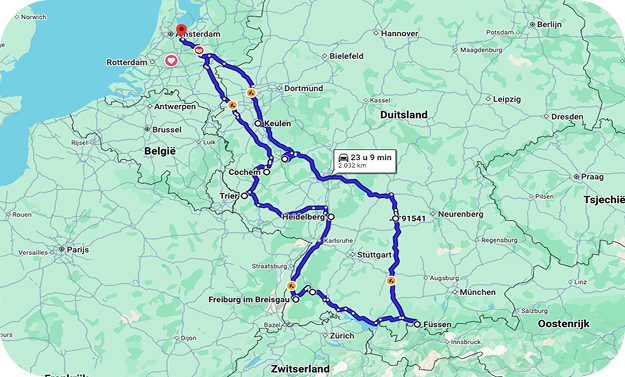
Day 1: Netherlands – Cochem, approx. 205 mi (330 km) – 4 hours
After picking up your camper, drive through the Dutch province of Limburg and cross into Germany, heading toward the Moselle River. Once you leave the major highways behind, the scenery changes as the river winds between steep vineyard-covered slopes and small towns.
Cochem makes a convenient first base. After arriving, walk through the historic center with its half-timbered houses and market square, or visit Reichsburg Castle, which overlooks the town and the Moselle. There are several campgrounds and motorhome sites around Cochem, so you do not need to drive your camper into the town center.
Day 2: Cochem and the Moselle Valley
Leave the camper parked today. You can cycle along the Moselle, walk through the vineyards, or take a boat trip on the river. If you want to explore more of the surrounding area, consider visiting Beilstein or Bremm. Spending an extra day along the Moselle also gives the road trip a relaxed start, especially after the longer drive on Day 1.
Day 3: Cochem – Trier, approx. 65 mi (105 km) – 1.5 hours
Follow the Moselle south toward Trier. There is no need to rush this stretch: the smaller roads along the river are part of what makes this section of the route worthwhile. Along the way, you can stop in one of the wine towns in the Moselle Valley.
Trier's history stretches back to Roman times. The Porta Nigra is its best-known Roman monument, while the Roman bridge, baths, and other historic structures make the city a worthwhile cultural stop on this camper trip. It is generally more convenient to choose a campground or motorhome site outside the busiest part of the city center and continue on foot or by public transportation.
Day 4: Trier – Heidelberg, approx. 125 mi (200 km) – 2.5 hours
Today you leave the Moselle and head toward Heidelberg. The city sits on the Neckar River and is known for its historic center and castle on the hillside above town. Park your camper outside the center and allow an afternoon or evening to explore the Altstadt. Walk across the Alte Brücke and through the narrow streets around Hauptstraße. For views over Heidelberg, head toward the castle or one of the walking trails on the surrounding hills.
Day 5: Heidelberg – Freiburg im Breisgau, approx. 120 mi (190 km) – 2.5 hours
Continue southwest toward Freiburg and the Black Forest. Freiburg has a compact historic center centered around the Freiburg Minster and its distinctive Bächle, narrow water channels that run alongside several streets in the old town. Freiburg is also a useful place to stock up on groceries before continuing deeper into the Black Forest. If you have time, walk up the Schlossberg for views across the city and surrounding countryside.


Day 6: Freiburg – Triberg, approx. 40 mi (60 km) – 1 hr 15 min
Only a short drive is planned today. From Freiburg, head deeper into the Black Forest, where wooded roads, valleys, and traditional villages shape the landscape.
Around Triberg, you can go hiking and visit the waterfalls. Other destinations in the central Black Forest are also within easy reach. Because today's drive is short, there is plenty of time for a walk or a quiet afternoon at the campground.
Day 7: Triberg and the Black Forest
Spend a second day in the Black Forest. Depending on the weather, you can choose a longer hike, a bike ride, or a drive through the surrounding area. When traveling by camper, it is useful to check in advance where larger parking areas are located, as space can be limited in small villages and near popular trailheads. This rest day is also a convenient time to refill your water supply, buy groceries, and prepare the camper for the next part of the trip.
Day 8: Triberg – Füssen, approx. 160 mi (260 km) – 3.5 hours
Continue toward southern Bavaria. As you approach Füssen, the Alps become increasingly prominent on the horizon. Lakes, hiking trails, and several campgrounds surround Füssen, making the area well suited to a camper road trip.
The castles of Neuschwanstein and Hohenschwangau are located nearby. If you plan to visit one of the castles, check current visitor information in advance and reserve a time slot if necessary. Alternatively, take a walk around the Alpsee or explore Füssen's historic center.
Day 9: Füssen and the surrounding area
There is no need for a long drive today. Use the day to visit the castles, walk along one of the nearby lakes, or explore the rolling countryside and mountain scenery around Füssen. The area around Neuschwanstein can be busy during peak season. Arriving early and leaving the camper in a suitable designated parking area usually makes a visit more practical.
Day 10: Füssen – Rothenburg ob der Tauber, approx. 155 mi (250 km) – 3.5 hours
From Füssen, travel north through Bavaria. Much of today's journey follows the general direction of the Romantic Road (Romantische Straße), a well-known scenic route connecting historic towns across southern Germany.
Rothenburg ob der Tauber is one of its best-known stops. Within the old city walls, you will find half-timbered houses, squares, towers, and narrow streets. Toward the end of the afternoon, take a walk on or alongside the city walls, when many day visitors have already left.
Day 11: Rothenburg ob der Tauber – Würzburg, approx. 40 mi (65 km) – 1 hour
It is only a short drive to Würzburg, so you can spend the morning in Rothenburg before continuing north. Würzburg sits on the Main River and marks the northern end of the Romantic Road. The Würzburg Residence, Alte Mainbrücke, and vineyards surrounding the city give this stop a different character from the smaller towns of the previous few days. Stay at a campground or motorhome site and leave the camper parked while exploring the city center.
Day 12: Würzburg – Koblenz, approx. 135 mi (220 km) – 2.5 hours
Today the route turns west again. Koblenz lies at the confluence of the Moselle and Rhine rivers, which you can see clearly from Deutsches Eck.
If you have time after arriving, walk along the Rhine and Moselle or take the cable car across the Rhine toward Ehrenbreitstein Fortress when it is operating. Koblenz is also a logical overnight stop on the journey back toward the Netherlands.
Day 13: Koblenz – Cologne, approx. 70 mi (110 km) – 1.5 hours
Follow the Rhine north to Cologne. Cologne Cathedral (Kölner Dom) stands next to the city's main train station and is its most recognizable landmark. The Rhine promenade and Hohenzollern Bridge offer several good viewpoints of the cathedral and old town.
With a larger camper, staying outside the city center and using public transportation is usually more convenient. This avoids busy urban traffic and the challenge of finding a parking space large enough for your vehicle.
Day 14: Cologne – Netherlands, approx. 135 mi (220 km) – 2.5 hours
After breakfast, begin the final leg of the trip. From Cologne, travel through the Rhineland toward the Dutch border. Allow enough extra time for possible traffic delays and, if you are returning a rental vehicle, for refueling, cleaning, and returning the camper.
After about two weeks, you will have experienced several sides of Germany: the vineyards of the Moselle Valley, Roman heritage in Trier, the forests of the Black Forest, Alpine scenery around Füssen, and historic cities along the Romantic Road and Rhine.
Practical information for this route
-
Trip length: 14 days. If you have 16 or 17 days, consider adding an extra day along the Moselle, in the Black Forest, or around Füssen.
-
Best time to travel: May through September is generally a practical period for this route, with longer daylight hours and a wide choice of open campgrounds and outdoor activities. Spring and fall can be quieter, but check seasonal opening dates for campgrounds, attractions, and mountain facilities in advance.
-
Campgrounds and motorhome sites: Germany has a large network of campgrounds and dedicated motorhome sites, often called Wohnmobilstellplätze. Overnight camping in natural areas is not automatically permitted, so use official overnight facilities and check local regulations.
-
Low-emission zones: Some German cities have low-emission zones (Umweltzonen). Requirements vary by location and can change over time. Before traveling, check which cities on your route have an Umweltzone and whether your camper needs a valid emissions sticker.
-
Visiting cities: In places such as Heidelberg, Freiburg, Würzburg, and Cologne, it is generally easier to leave the camper at a campground, motorhome site, or suitable park-and-ride facility. This avoids searching for parking spaces large enough for the vehicle.
-
Mountain roads: Roads around the Black Forest and Füssen can be winding, and driving times may be longer than the mileage suggests. Keep the dimensions and weight of your camper in mind when planning these sections.
-
Reservations: Advance reservations are advisable at popular campgrounds in July and August, particularly in the Black Forest and around Füssen. For popular attractions such as Neuschwanstein, check current visitor and reservation information before your visit.
-
Shortening the route: This itinerary is easy to adapt. For a 10- to 12-day trip, you could skip Heidelberg and Würzburg or spend less time in the Black Forest.
Want to drive this route yourself? Explore options to rent a camper in the Netherlands or compare options for camper rentals in Germany. You can then adapt the itinerary to your travel dates, preferred camper type, and pickup location.